


摘要
阐明抗金黄色葡萄球菌复方精油的药效物质基础及其作用机制,该研究采用水蒸气蒸馏法制备艾草、留兰香、牛至单方精油及两种复方精油(复方精油1、复方精油2),利用气相色谱-质谱联用技术分析抗金黄色葡萄球菌精油的活性成分,采用滤纸片扩散法评价各精油对金黄色葡萄球菌的抑菌活性,综合运用网络药理学和分子对接模拟技术,探究活性最强复方精油(复方精油2)的潜在抗菌作用机制。结果表明:(1)复方精油2含有41种化学成分,其主要活性成分包括百里香酚(29.33%)、香芹酚(9.13%)等。(2)单方精油和复方精油的抑菌活性强弱顺序为复方精油2 [(40.18±1.67) mm]> 牛至精油 [(38.64±1.47)mm]> 复方精油1 [(24.87±0.85) mm]> 艾草精油 [(13.12±0.56) mm]> 留兰香精油 [(11.28±0.75) mm],复方精油2抗金黄色葡萄球菌作用最强。(3)复方精油2可通过多靶点协同作用抑制金黄色葡萄球菌,调控SRC、MAPK3等核心靶点,并影响中性粒细胞胞外诱捕网形成和表皮生长因子受体酪氨酸激酶抑制剂耐药性等信号通路;多种活性成分与核心靶点具有良好的结合能。综上认为,复方精油2是一种有效的抗金黄色葡萄球菌植物源抗菌剂,其独特的化学成分及多靶点、多通路协同作用机制,为其作为天然抗菌剂的深入开发应用提供了重要依据。
Abstract
In order to elucidate the pharmacodynamic material basis and mechanisms of underlying the anti-bacterial efficacy of compound essential oils against Staphylococcus aureus, this study employed steam distillation method to prepare single essential oils of Artemisia argyi, Mentha spicata and Origanum vulgare, and two compound essential oils (Compound essential oil 1 and Compound Essential Oil 2); gas chromatography-mass spectrometry (GC-MS) analysis was performed to identify the active constituents of the essential oils exhibiting anti-Staphylococcus aureus activity; the filter paper diffusion assay was utilized to evaluate the anti-bacterial activity of each essential oil against Staphylococcus aureus; network pharmacology and molecular docking simulations were integrated to investigate the potential anti-bacterial mechanism of the most bioactive compound essential oil (Compound Essential Oil 2). The results were as follows: (1) Compound essential oil 2 comprised 41 chemical constituents, with its primary bioactive constituents including thymol (29.33%) and carvacrol (9.13%). (2) The order of anti-bacterial efficacy among single and compound essential oils was Compound Essential Oil 2 [(40.18±1.67) mm] > Origano vulgare essential oil [(38.64 ± 1.47) mm] > Compound essential oil 1 [(24.87±0.85) mm] > Artemisia argyi essential oil [(13.12 ± 0.56) mm] > Mentha spicata essential oil [(11.28 ± 0.75) mm]. Compound Essential Oil 2 exhibited the strongest inhibitory effect against Staphylococcus aureus. (3) Compound Essential Oil 2 exerted inhibition of Staphylococcus aureus through multi-target synergistic effects, modulating core protein targets including SRC and MAPK3, and regulating signaling pathways of notably neutrophil extracellular trap formation, drug resistance of epidermal growth factor receptor tyrosine kinase inhibitor (EGFR-TKI) and so on. Several bioactive constituents showed favorable binding energies with core targets. These collective findings demonstrate that Compound Essential Oil 2 is a novel plant-derived anti-Staphylococcus aureus candidate, and its unique chemical constituents, multi-target and multi-pathway synergistic mechanism provide important basis for the in-depth development and application as a natural anti-bacterial agent.
金黄色葡萄球菌(Staphylococcus aureus)作为一种常见的获得性感染的病原体之一,可引起皮肤软组织感染、肺炎、菌血症、心内膜炎乃至中毒性休克综合征等多种严重疾病(Tong et al., 2015)。尽管β-内酰胺类抗生素等在临床上被广泛应用,但是金黄色葡萄球菌对抗生素的耐药性问题日益突出(Prestinaci et al., 2015; Kajihara et al., 2020),现有抗生素被报道有潜在的毒副作用(Fair & Tor, 2014)。开发新型、安全、有效、不易产生耐药性的抗菌药物,已成为当前亟待解决的问题。植物精油因其天然、绿色、广谱抗菌活性、较低耐药风险而备受关注(Nazzaro et al., 2017; Buckova et al., 2018)。艾叶、留兰香、牛至等植物精油的抗菌活性已被研究报道(Rodrigues et al., 2018; Zamaniahari et al., 2022; Yu et al., 2023),但这些精油的药效成分与作用机制不清楚,抗金黄色葡萄球菌研究也较少。因此,本研究以艾叶、留兰香和牛至的单方及其配伍复方精油为研究对象,开发一种新型抗金黄色葡萄球菌复方精油,为植物精油复方抗菌制剂的开发提供理论依据。
1 材料与方法
1.1 药材和菌株
艾叶、留兰香和牛至购自贵阳太升中药材市场,经贵州医科大学药学院刘绍欢正高级实验师鉴定为正品。实验菌株为金黄色葡萄球菌ATCC 29213,于LB固体培养基活化后挑取单菌落转接LB液体培养基,37 ℃培养8 h(对数生长期),调整菌液浓度至1×10⁶ CFU·mL-1,备用。
1.2 精油制备
将艾草、牛至、留兰香的干燥药材进行切碎处理,分别置于1 000 mL圆底烧瓶中,按固液比1∶8(g·mL-1)加纯水浸泡,通过水蒸气蒸馏法依次提取各植物精油。向精油样品加入少许无水硫酸钠,过滤,最终得到艾草精油、留兰香精油、牛至精油。将艾草精油、留兰香精油、牛至精油按体积比1∶1∶1混合得到复方精油1。称取一定质量的艾草、留兰香和牛至药材,按质量比1∶1∶1进行混合后,通过水蒸气蒸馏法提取混合药材精油,经过少许无水硫酸钠、过滤后,得到复方精油2。所有精油分别装于棕色玻璃瓶中,4 ℃储存待用。
临用前,分别取适量各单方精油和复方精油,按体积比1∶10加入色谱甲醇溶解各精油,经0.22 μm微孔滤膜过滤,分别配制得到待测精油供试品溶液,用于GC-MS分析和抗金黄色葡萄球菌活性研究。
1.3 GC-MS分析
岛津GCMS-TQ8050 NX气相色谱-三重四极杆质谱联用仪,岛津RTX-5MS毛细管色谱柱(30 m × 0.25 mm, 0.25 μm)。升温程序:60 ℃起始,保持2 min;5 ℃·min-1升温至180 ℃保持2 min;20 ℃·min-1升至280 ℃保持3 min。载气He,流量1.0 mL·min-1;进样口温度280 ℃;不分流进样1.0 μL。质谱条件: EI源,离子源280 ℃,质量扫描范围m/z为50~500。NIST 2017质谱库及文献比对用于植物精油挥发性成分鉴定。
1.4 抗金黄色葡萄球菌活性
采用滤纸片扩散法,将浓度为1×10⁶ CFU·mL-1的金黄色葡萄球菌悬液150 μL均匀涂布于LB固体培养基平板上,贴附直径6 mm的含待测精油样品的无菌滤纸片。37 ℃培养24 h后,游标卡尺测量各精油抑菌圈的直径(n=3)。
1.5 复方精油抗金黄色葡萄球菌的作用机制
针对GC-MS分析得到复方精油2的化学成分,借助SwissADME筛选出复方精油2的候选活性化合物,SwissTargetPrediction获得候选化合物的作用蛋白靶点,去除无对应靶点的化学成分。通过GeneCards、OMIM和NCBI数据库汇总金黄色葡萄球菌疾病靶点。将复方精油2抗金黄色葡萄球菌的交集靶点,通过DAVID在线工具进行基因本体(gene ontology, GO) 功能和京都基因与基因组百科全书(kyoto encyclopedia of genes and gnomes, KEGG) 通路富集分析。构建交集靶点的蛋白质-蛋白质互作(protein-protein interaction, PPI)网络和“复方精油2-成分-靶点-通路-抗金黄色葡萄球菌”网络,最终筛选出复方精油2抗金黄色葡萄球菌的活性成分、核心靶点与药物作用机制。
开展复方精油2抗菌活性成分、核心靶点的分子对接分析。对复方精油2抗菌活性成分的分子三维结构进行MM2力场优化。从RCSB蛋白数据库中获得核心靶点蛋白的三维结构文件,经AutoDockTools 1.5.6软件对蛋白晶体结构进行初始化处理,包括去除溶剂分子、水分子和配体,加氢、合并非极性氢、能量初始化等,准备pdbqt文件,对接位点定义与相应的原始配体活性位点对应。AutoDock Vina 1.1.2执行分子对接,选取结合能最低、亲和力最高的构象,导入Discovery Studio 2019进行可视化分析。
2 结果与分析
2.1 单方精油与复方精油成分鉴定
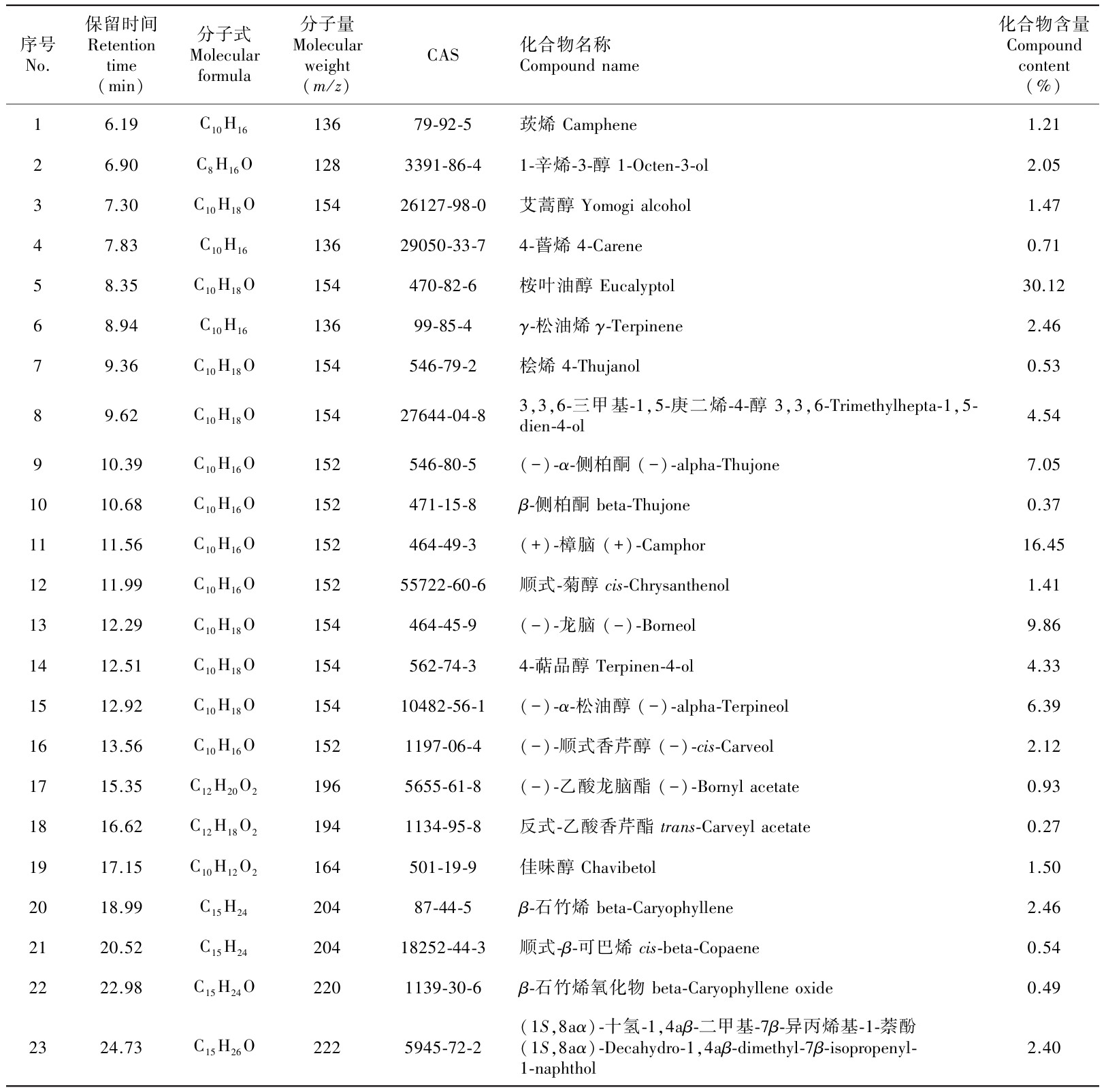
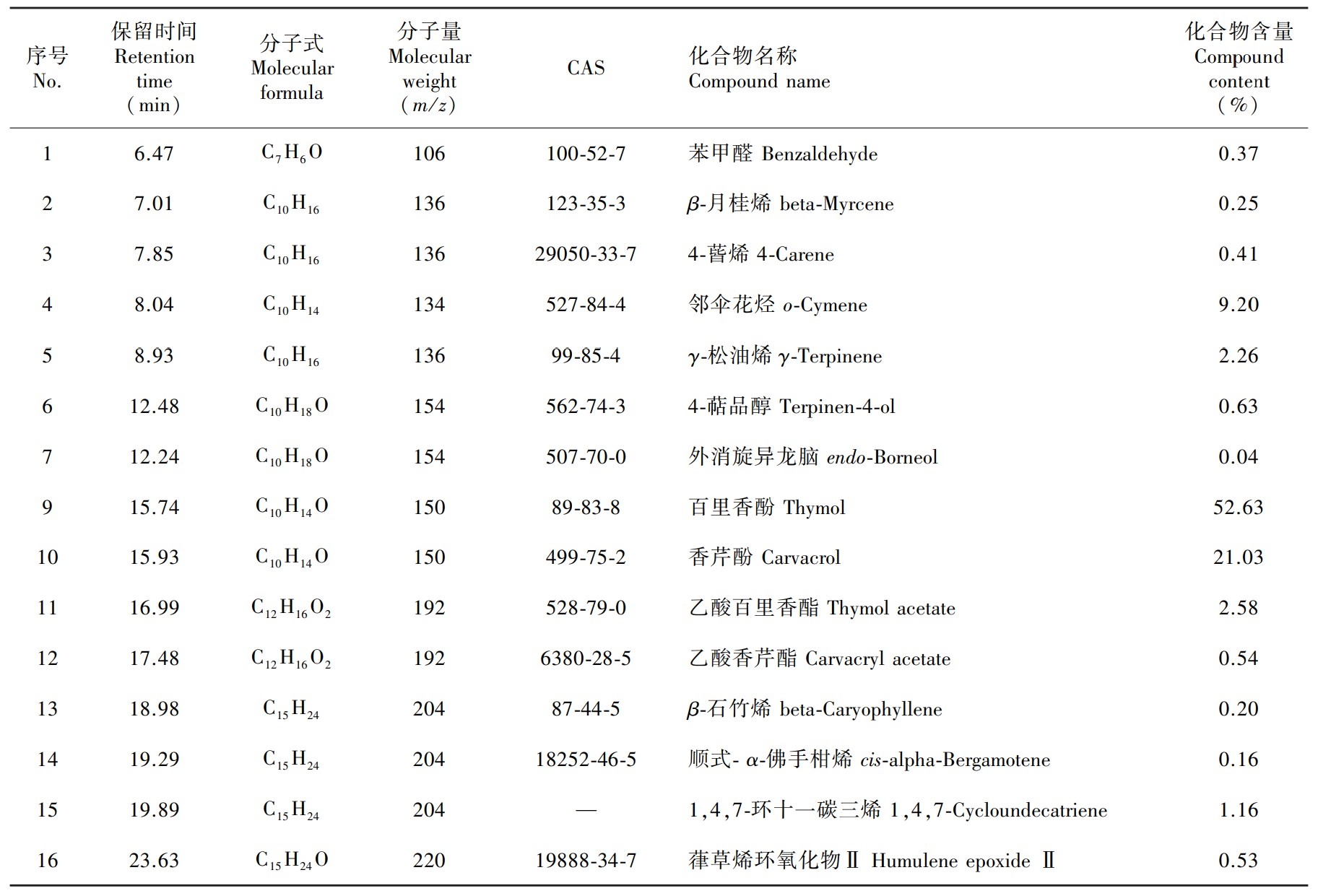
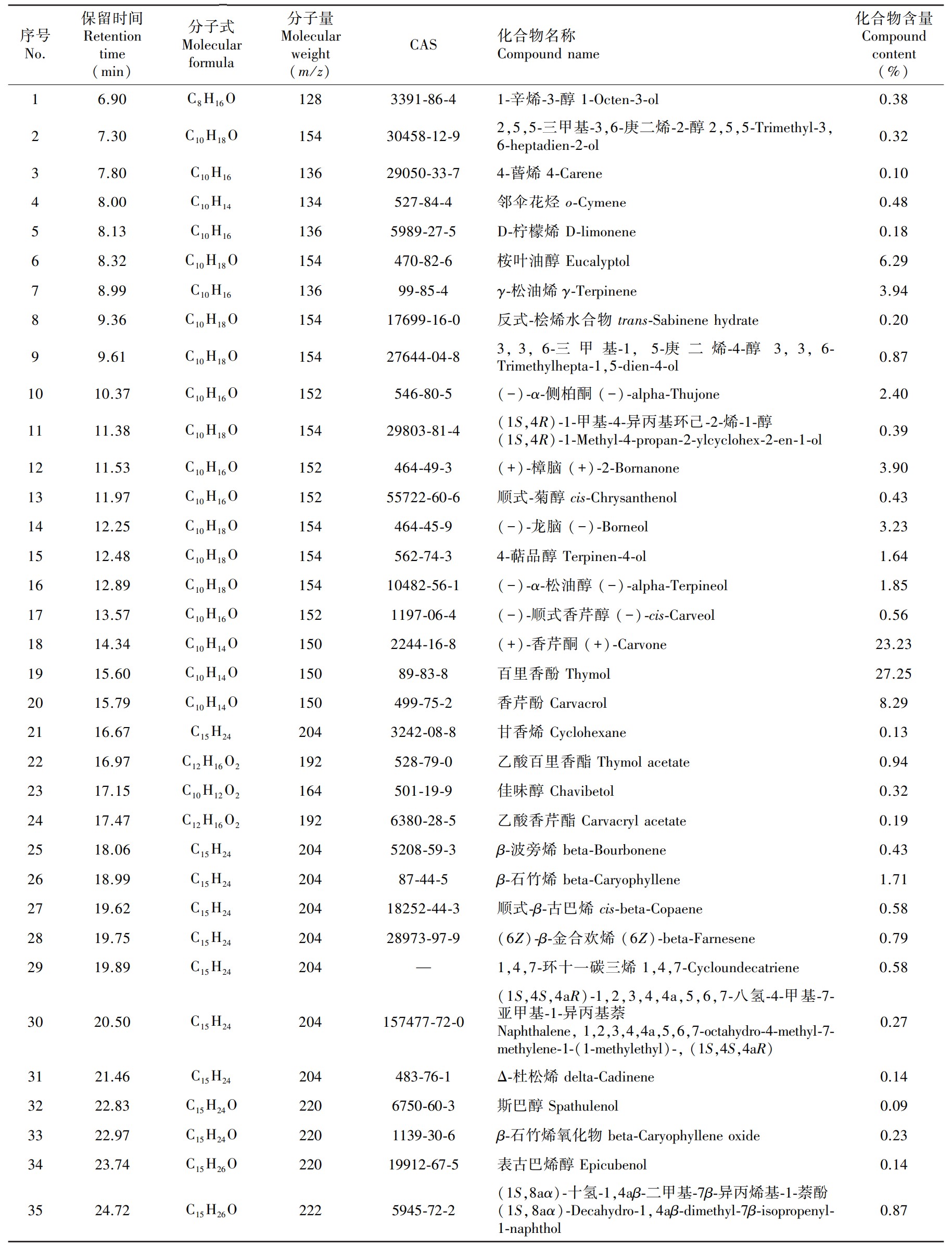
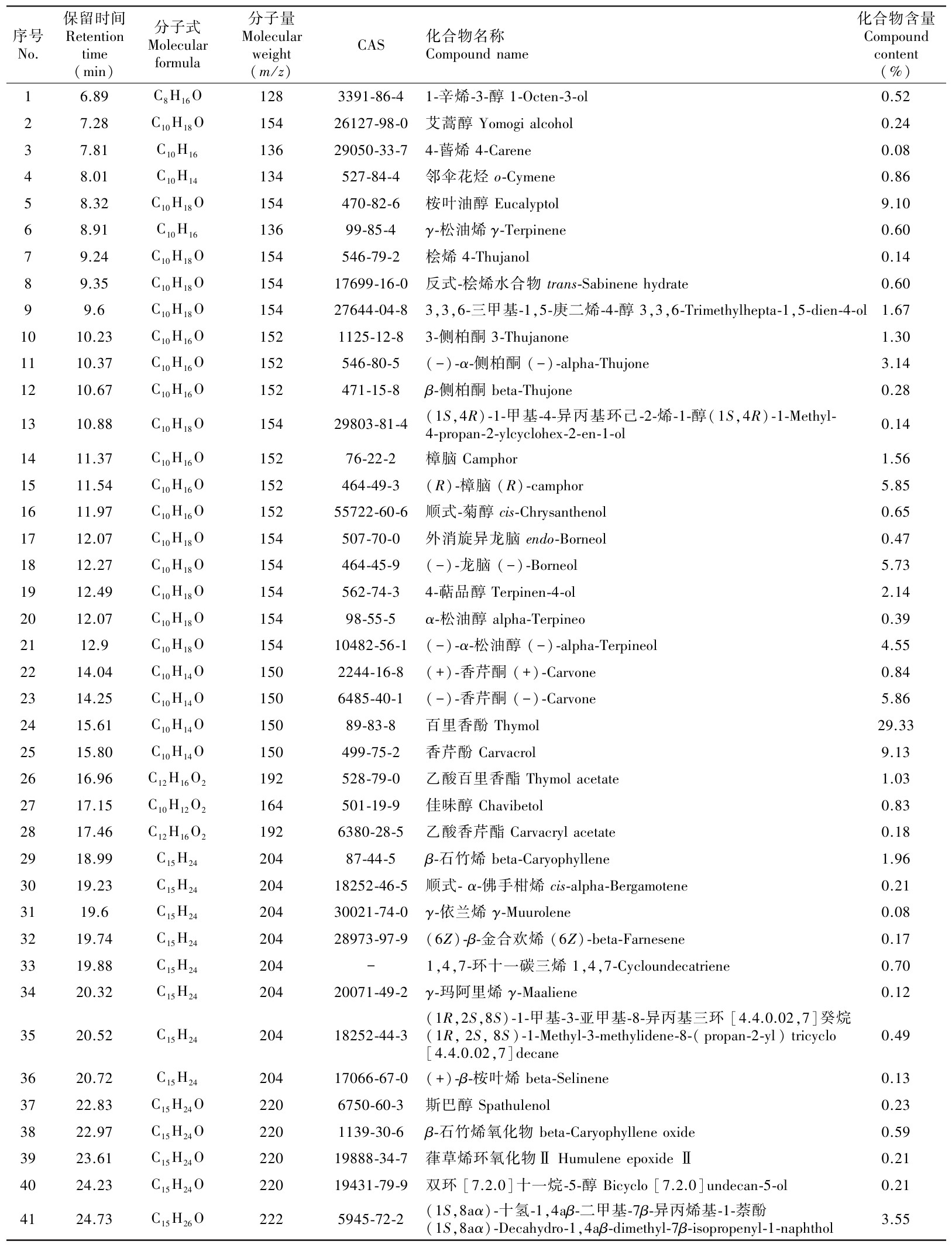
鉴于中药复方物质组成的复杂性,采用气相色谱-质谱联用法(GC-MS)技术对单方精油和复方精油进行组分分析,图1展示了复方精油2在EI离子化模式下的总离子流(total ion current,TIC),GC-MS分析鉴定出艾草精油成分23种(表1),留兰香精油成分29种(表2),牛至精油成分16种(表3)。2种配伍方式得到的复方精油化学成分更丰富:在复方精油1中鉴定出35种成分(表4),在复方精油2中鉴定出41个化学成分(表5、图1)。
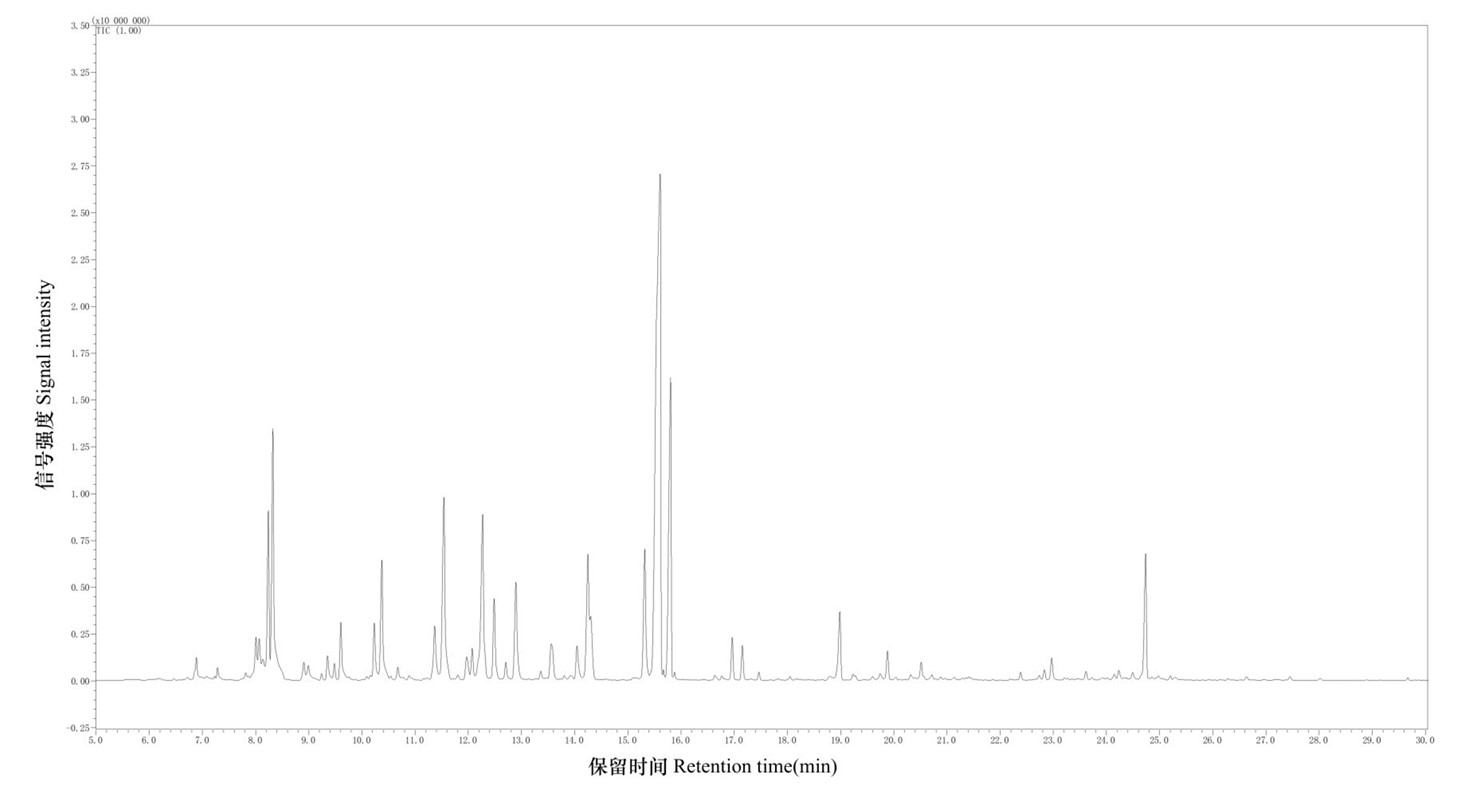
图
1
复方精油2的总离子流气相-质谱色谱图
Fig.
1
GC-MS total ion current chromatogram of Compound Essential Oil 2
表
1
GC-MS鉴定艾草精油中的天然化合物
Table
1
Identification of natural compounds in Artemisia argyi essential oil by GC-MS
表
2
GC-MS鉴定留兰香精油中的天然化合物
Table
2
Identification of natural compounds in Mentha spicata essential oil by GC-MS

表
3
GC-MS鉴定牛至精油中的天然化合物
Table
3
Identification of natural compounds in Origanum vulgare essential oil by GC-MS
表
4
GC-MS鉴定复方精油1的天然化合物
Table
4
IdentificationofnaturalcompoundsinCompoundEssentialOil1byGC-MS
表
5
GC-MS鉴定复方精油2的天然化合物
Table
5
Identification of natural compounds in Compound Essential Oil 2 by GC-MS
2.2 单方精油与复方精油抗菌活性筛选
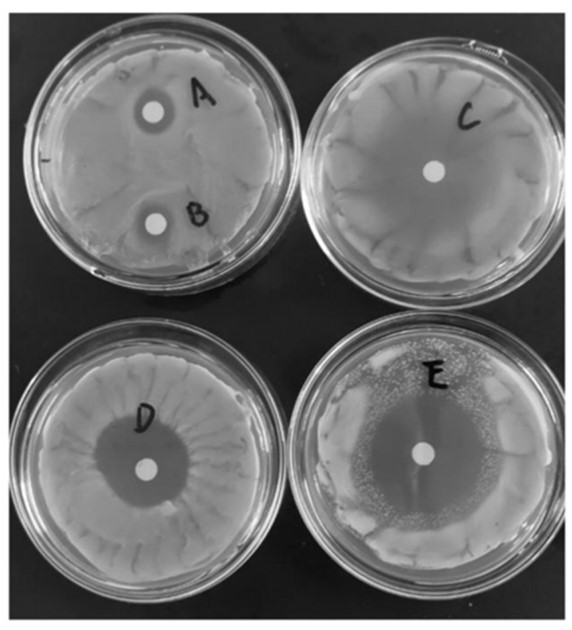
滤纸片扩散法抑菌结果(图2)显示,单方精油对金黄色葡萄球菌的抑菌圈直径分别为艾草精油(13.12±0.56)mm、留兰香精油(11.28±0.75)mm、牛至精油(38.64±1.47)mm。复方精油1抑菌圈直径为(24.87±0.85)mm,抗菌活性与艾草精油、留兰香精油相当,弱于牛至精油。复方精油2表现出最强抑菌活性,抑菌圈直径达(40.18±1.67)mm。基于此,选择复方精油2进行后续研究。
图
2
艾草精油(A)、留兰香精油(B)、牛至精油(C)、复方精油1(D)和复方精油2(E)抑制金黄色葡萄球菌的状态
Fig.
2
Bacteriostatic states of Artemisia argyi essential oil(A), Mentha spicata essential oil(B), Origanum vulgare essential oil(C), Compound Essential oil 1(D) and Compound Essential oil 2(E) against Staphylococcus aureus
2.3 复方精油2潜在抗金黄色葡萄球菌靶点收集
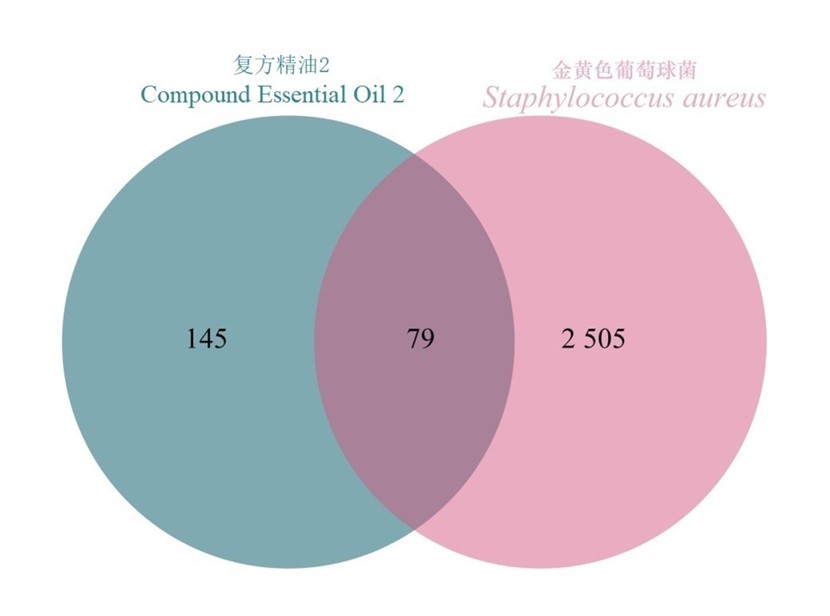
SwissTargetPrediction预测得到复方精油2成分相关靶点蛋白共224个,通过GeneCards、NCBI数据库及OMIM数据库检索去重后得到抑制金黄色葡萄球菌关靶点2 584个。利用复方精油2成分靶点与金黄色葡萄球靶点绘制韦恩图(图3),图3显示它们存在79个潜在抗菌靶点。
图
3
复方精油2与金黄色葡萄球菌的韦恩图
Fig.
3
Venn diagram between Compound Essential Oil 2 and Staphylococcus aureus
2.4 PPI网络的构建
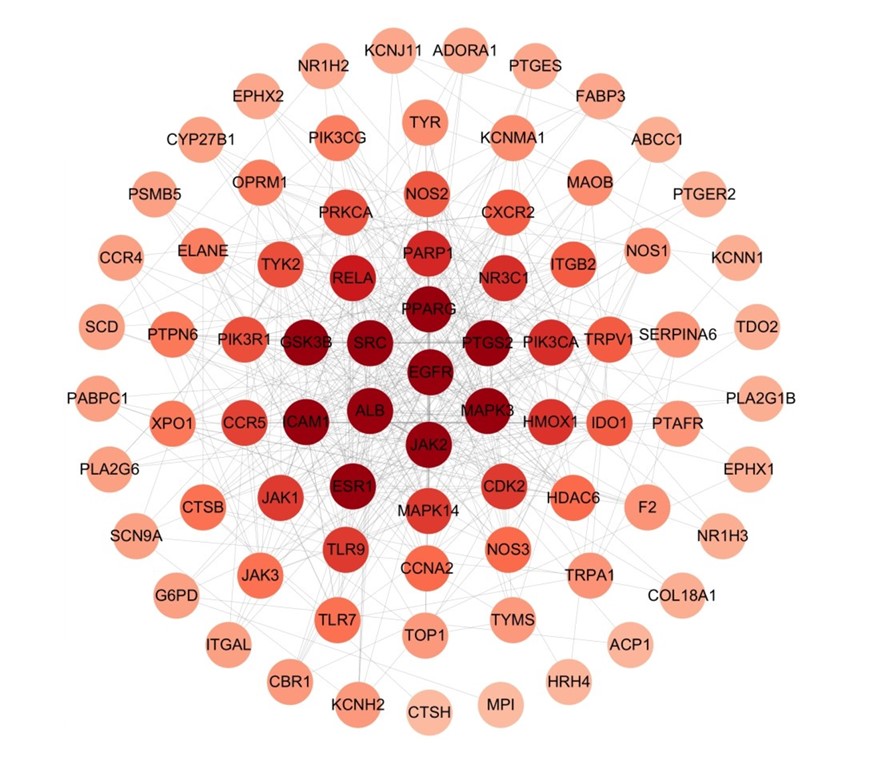
借助String数据库和Cytoscape v3.10软件,分析上述79个潜在抗菌靶点,构建PPI网络。PPI网络分析结果见图4,图中的颜色越深表示排名越靠前,EGFR、MAPK3、SRC、PTGS2、JAK2、PIK3CA、RELA、ICAM1、ESR1、MAPK14为排名前10的靶点,分布在整个网络的中心,起关键的调控作用。
图
4
复方精油2抗金黄色葡萄球菌的PPI网络图
Fig.
4
PPI network of Compound Essential Oil 2 against Staphylococcus aureus
2.5 GO及KEGG富集分析
运用DAVID数据库对PPI网络中的79个靶点进行GO和KEGG富集分析,并将排名靠前的富集结果进行可视化。由图5可知,复方精油2抗金黄色葡萄球菌作用机制GO功能富集分析中主要涉及生物过程(如炎症反应、对外源物刺激的反应、胞质钙离子浓度的正向调节等)、细胞组分(如胞质溶胶、细胞质、质膜等)和分子功能(如酶结合、血红素结合、生长激素受体结合等)。KEGG通路富集筛选前15条信号通路(P<0.05),结果(图6)显示复方精油2抗金黄色葡萄球菌涉及表皮生长因子受体酪氨酸激酶抑制剂耐药性、中性粒细胞胞外诱捕网形成等信号通路。

图
5
复方精油2抗金黄色葡萄球菌的GO富集分析柱状图
Fig.
5
Histogram of GO enrichment analysis of Compound Essential Oil 2 against Staphylococcus aureus

图
6
复方精油2抗金黄色葡萄球菌的 KEGG富集分析气泡图
Fig.
6
Point plots of KEGG enrichment analysis of Compound Essential Oil 2 against Staphylococcus aureus
2.6 “复方精油2-成分-靶点-通路-抗金黄色葡萄球菌”网络的构建
以复方精油2和金黄色葡萄球菌为中心,用PPI网络中的79个靶点及KEGG富集分析得到的前15个通路绘制“复方精油2-活性成分-靶点-通路-金黄色葡萄球菌”网络图(图7)。取该图度值前10的靶点和PPI网络前10的靶点交集,得到2个关键靶点分别为MAPK3和SRC。
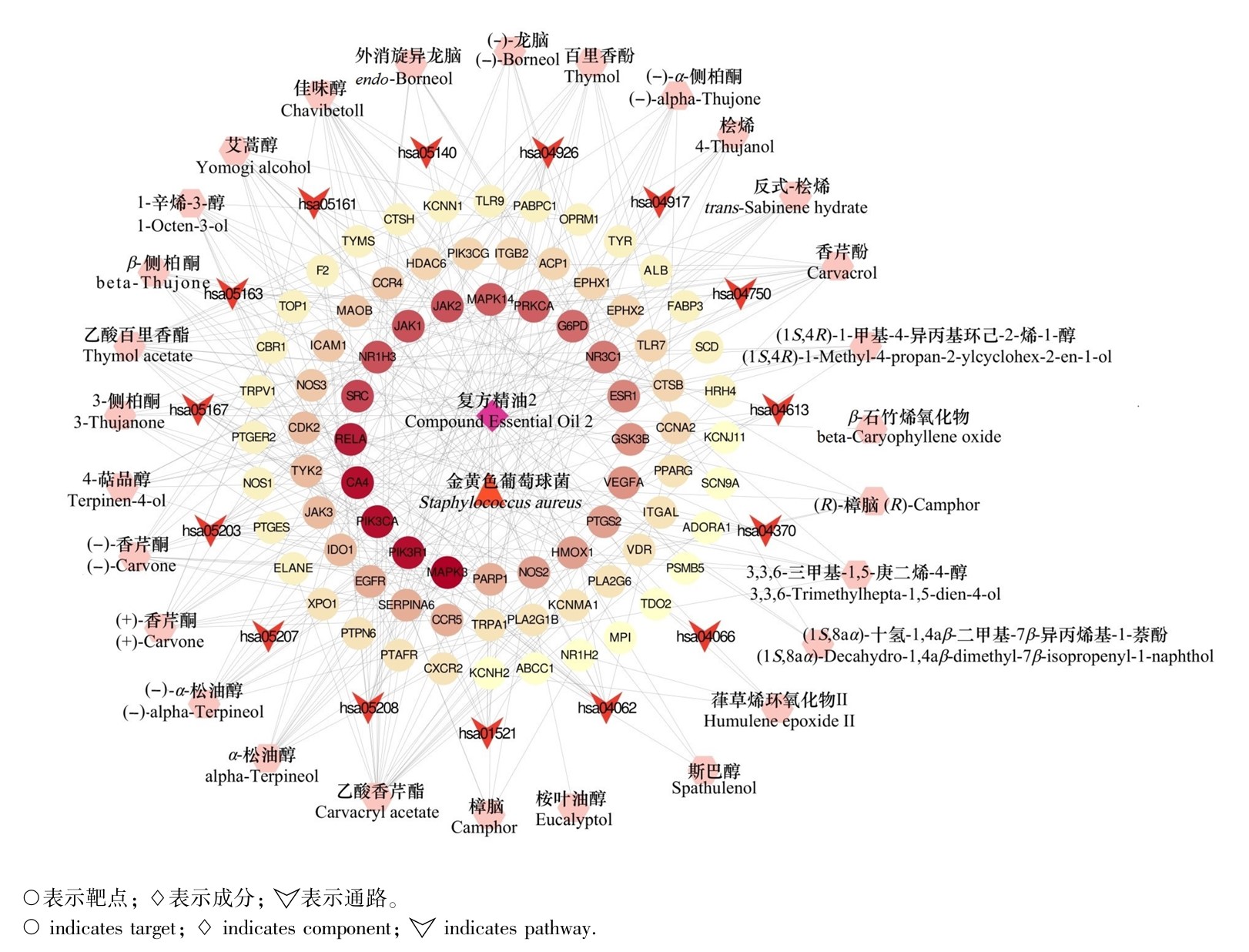
图
7
“复方精油2-成分-靶点-通路-抗金黄色葡萄球菌”网络图
Fig.
7
“Compound Essential Oil 2-compounds-target-pathway-against Staphylococcus aureus” network map
2.7 分子对接
将得到的2个潜在靶点MAPK3(PDB ID:4qtb)和SRC(PDB ID:2h8h)与28个活性化合物进行分子对接,配体与受体结合时所需的结合自由能越低,则说明其结合构象越稳定。通常最小结合能≤0 kcal·mol-1(1 cal=4.4 J),认为目标分子与蛋白质可自发结合;最小结合能≤-5.0 kcal·mol-1,说明结合活性较好;最小结合能≤-7.0 kcal·mol-1,说明结合活性强烈。结合能越小,则代表活性成分与靶点结合能力越强、发生作用的可能性越高。对接结果(图8、图9)为筛选出的成分和靶点提供了可靠的依据(Joon et al., 2023)。
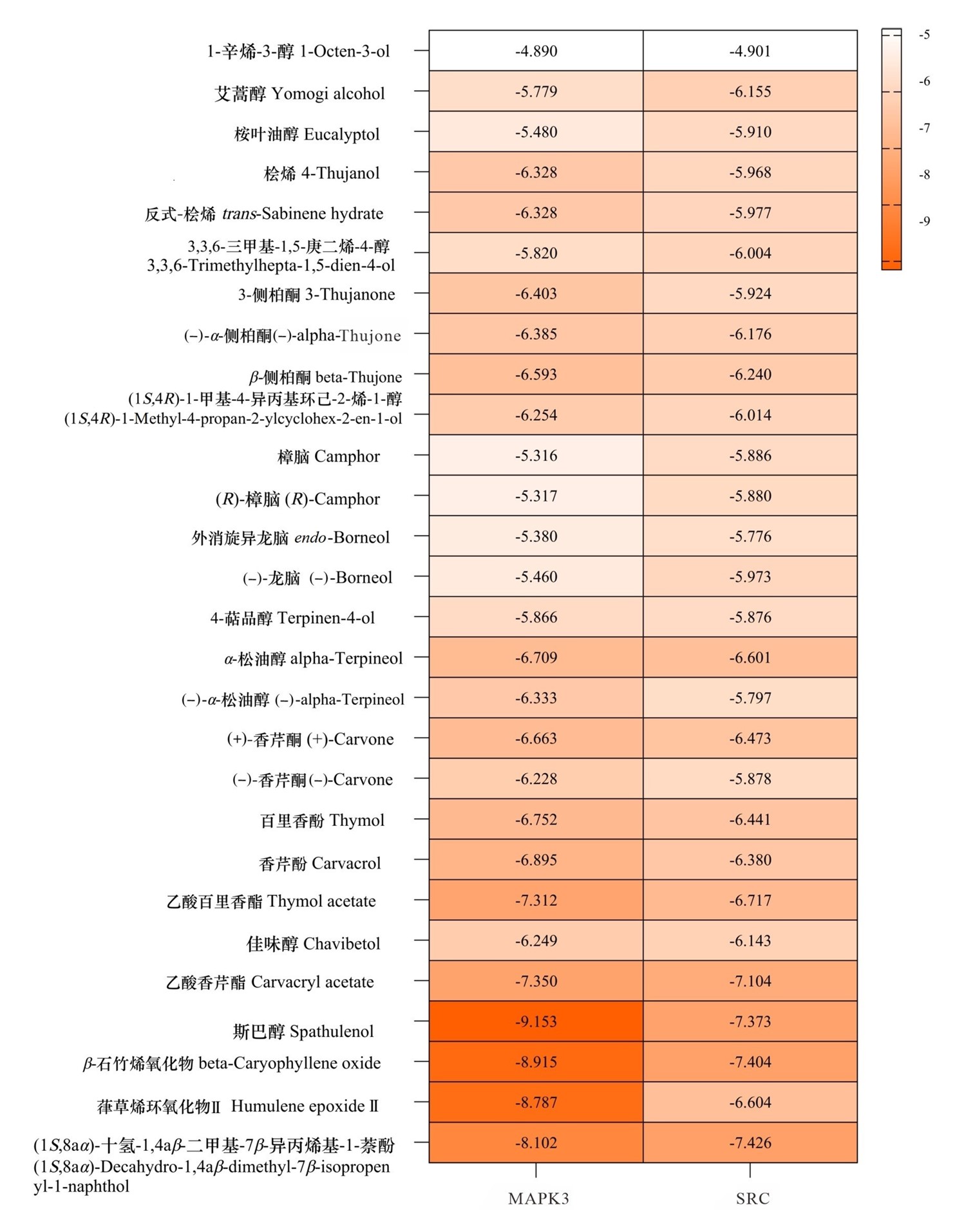
图
8
复方精油2抗金黄色葡萄球菌活性成分与关键靶点的分子对接热图
Fig.
8
Molecular docking heatmap of Compound Essential Oil 2 against Staphylococcus aureus active compounds with key targets
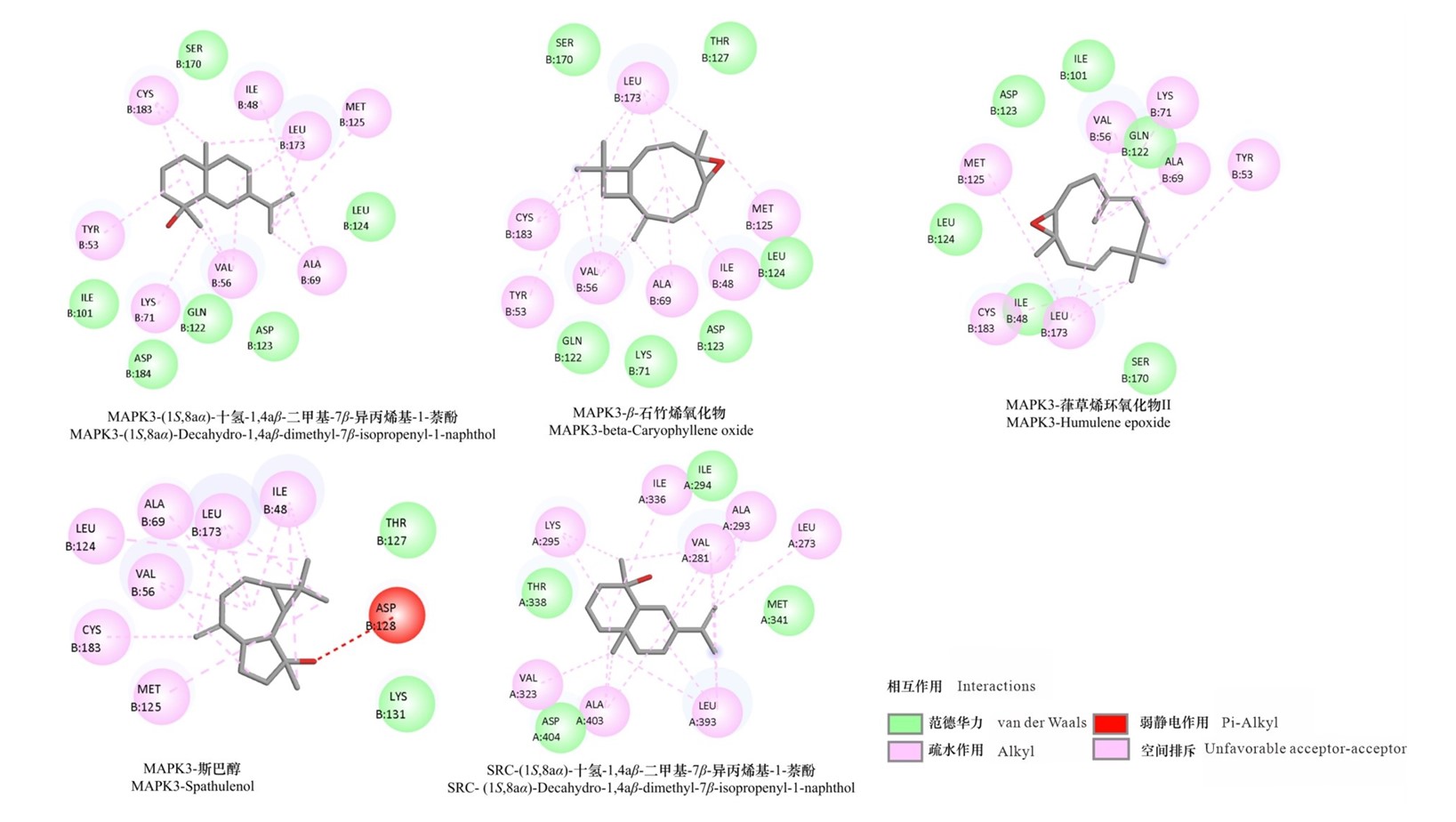
图
9
复方精油2抗金黄色葡萄球菌成分与核心靶点分子对接可视图
Fig.
9
Molecular docking visual diagrams of compounds in Compound Essential Oil 2 and core targets against Staphylococcus aureus
3 讨论与结论
金黄色葡萄球菌是一种常见的革兰氏阳性食源性致病菌在其生长过程中可产生多种毒素(Zhao et al., 2018; Touaitia et al., 2025)。其中,肠毒素具有极强的热稳定性,常规烹饪难以破坏,是引发食物中毒的主要原因。此外,该菌极易产生耐药性,构成严重的公共卫生问题(Kochetkov, 2024)。目前,抗生素疗法是治疗金黄色葡萄球菌感染的主要手段,然而抗生素的滥用及使用不当加剧了耐药性问题,导致有效治疗选择减少,部分耐多药菌株的出现甚至使特定抗生素疗法失效。值得注意的是,强效抗生素的使用可能破坏肠道正常微生物群落,这不仅可能促进耐药菌种的定植与播散,其非选择性作用还可能清除有益菌群,进而引发菌群失调和继发感染风险(Schwartz et al., 2021)。因此,探索和研究新型治疗策略(包括发掘传统医学中的草本药物资源)显得尤为重要。
抑菌实验表明,复方精油2的抑菌活性显著优于单方精油、复方精油1,抑菌圈直径达40.18 mm。这证实了复方配伍通过协同作用可显著提升抗菌效能,与近年提出的“精油多组分协同抗菌模型”高度吻合(Bassole& Juliani, 2012; Ju et al., 2020)。
GC-MS分析发现艾草精油的主要成分为桉叶油醇(30.12%)、(+)-樟脑(16.45%)、(-)-龙脑(9.86%)和(-)-α-侧柏酮(7.05%),留兰香精油的主要成分为(+)-香芹酮(57.07%)和(-)-香芹酮(16.97%),牛至精油的主要成分为百里香酚(52.63%)和香芹酚(21.03%),均与文献中报道的一致(Cirino et al., 2014; Moradi-Sadr et al., 2023; Guo et al., 2023)。复方精油2含41种成分,其中百里香酚(29.33%)、香芹酚(9.13%)、桉叶油醇(9.10%)等已被证实具有广谱抗菌活性。
网络药理学结果显示,复方精油2抗金黄色葡萄球菌的作用过程中主要涉及SRC、MAPK3等核心靶点,分子对接结果表明大部分活性成分与核心靶点有较好的结合活性。SRC是一种酪氨酸激酶,参与多种细胞信号传导和调控过程。作为SRC家族成员之一,SRC-3被发现在宿主防御细胞外细菌病原体中起着至关重要的保护作用(Xia et al., 2021)。KEGG通路分析显著富集于表皮生长因子酪氨酸激酶抑制剂耐药性、中性粒细胞胞外诱捕网信号形成通路,表明复方精油2可能通过干扰细菌侵染相关靶点(如EGFR)发挥抗菌作用(Breshears et al., 2016; Bitschar et al., 2019)。EGFR是一种重要的细胞膜受体,通过激活多个信号传导途径参与细胞的增殖、存活和分化(Sabbah et al., 2020)。EGFR信号还调控焦点黏附(黏着斑)的形成。焦点黏附是细胞与胞外基质(extracellular matrix,ECM)相连接的复杂结构,通过整合蛋白(integrins)及其他细胞骨架蛋白(如肌动蛋白丝/微管)与细胞内骨架相连。这些连接结构的形成和解离对细胞迁移至关重要,它们可为细胞在基质上的移动提供必要的牵引力并介导力的传递(Rao et al., 2020)。
综上所述,本研究基于GC-MS、抗菌实验、网络药理学以及分子对接技术研究发现,复方精油2可能通过EGFR等信号通路调控SRC等基因的表达,从而发挥抗金黄色葡萄球菌活性。为进一步证实复方精油2具有明确的抗金黄色葡萄球菌效果,本团队将从网络药理学和分子对接筛选出来的核心成分用于下一步的体外抑菌实验进行验证。通过此类多维度科学分析,从系统层面揭示复方精油2抗金黄色葡萄球菌多靶点、多途径的分子作用机制,进而为后续研究复方精油提供科学依据及思路。